|
original
of “By Invitation” piece published in The Economist on September 9, 2026. Whither thou goest Jerusalem, goest Israel? by Dan Ben-David Israel is a story of
profound changes on massive scales at extraordinary speeds. Many have driven
remarkable progress, while others, particularly in recent years, literally
threaten the country’s future – chief among them the exponential growth of very
poorly educated parts of the population. The parliamentary elections on October
27th may be Israel’s last chance to pull
back from a demographic-democratic point of no return by making the policy
changes needed to return the country to a sustainable trajectory. In 1949, a year after
independence, agriculture comprised 64% of Israel’s exports. Within seven
decades that share collapsed to 0.6%. These days, high-tech is Israel’s primary
engine of growth, accounting for roughly half of its exports. This outcome was not
happenstance. Though relatively poor at the time, Israel built research
universities during its first two and a half decades, with university faculty’s
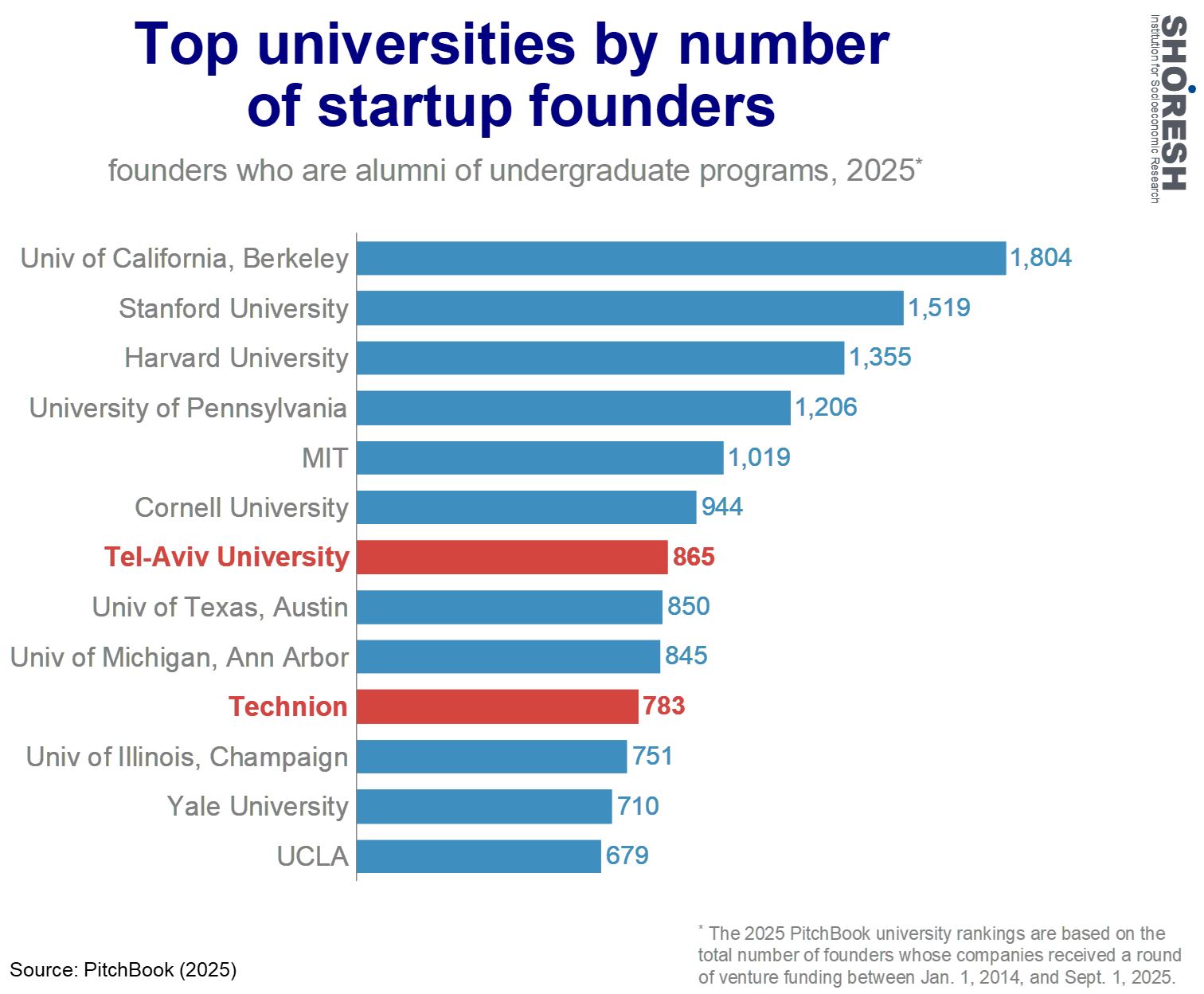
share of the population rising over nine-fold. Today, two Israeli universities,
Tel Aviv University and the Technion, are among the world’s top ten for
producing startup founders, according to Pitchbook. In recent years Israel’s
venture-capital investment as a share of GDP was more than twice the level in
America and over 15 times the average of all other OECD countries, while its
foreign-financed R&D share was 13 times the OECD average.
And yet Israel’s
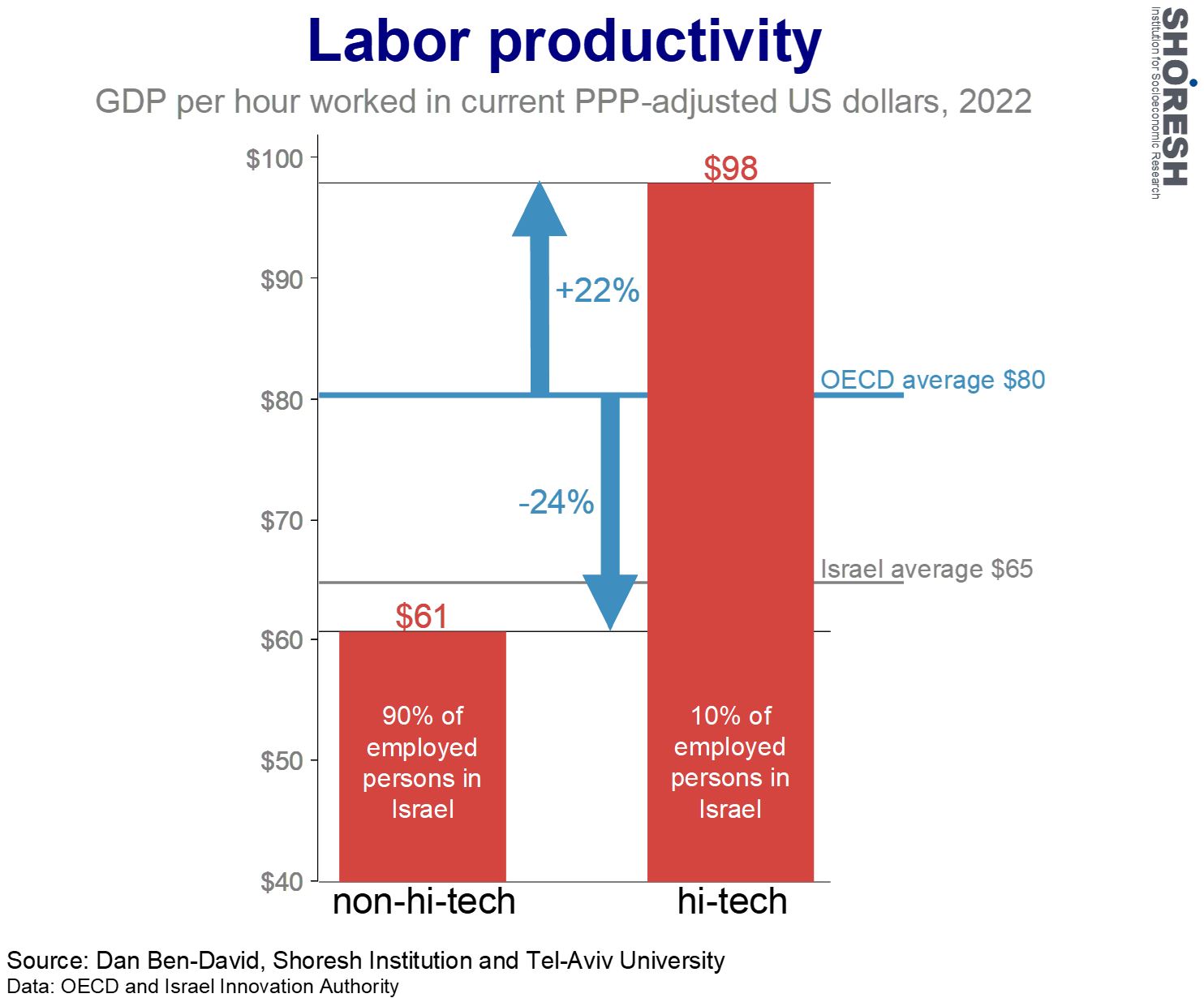
overall labor productivity is in the bottom half of OECD countries. In 2022 GDP
per hour worked in high-tech was 22% above the OECD average. In the rest of the
economy, where roughly 90% of Israelis work, it was 24% below. In 2024, 20% of
Israel’s workforce paid 93% of the country’s income tax, up from 83% in 2000,
while half the workforce was too poor to reach the income-tax threshold. In a
country of 10 million, just 300,000 people work in high-tech jobs within the
high-tech sector, as physicians or as senior faculty in research universities.
A key driver of this
asymmetry has been an education system that is one of the developed world’s
most dysfunctional. Israel ranks near the bottom of the OECD in PISA’s
mathematics, science and reading exams. Roughly half of Israel’s children
receive a core education below levels in many developing countries. Worse, this
cohort belongs to its fastest-growing population groups, posing a growing
threat to the nation’s future. Israel’s current government is, in no small
measure, a product of the education provided to different population groups and
their changing demographic weights over time. One group in
particular, the Haredim, is propelling Israel’s current transformation. The
vast majority of these ultra-Orthodox Jews insist on a wholly separate
education system that deliberately deprives their children – particularly the
boys – of the core education needed for economic self-sufficiency and an
understanding of basic civil rights and liberties. Whereas most Israeli
population groups have fertility rates of around two children per woman, the
Haredi rate is nearly seven. Consequently, the Haredi share of the population
doubles every 25 years, far outpacing all other groups. In 2023, Haredim comprised
just 6% of 50-54-year-olds (grandparent’s generation), compared with 26% of
children under five (grandchildren’s generation). Israel’s towns
provide a glimpse of the magnitude of this challenge, and the speed of the
changes it is generating. The four municipalities with the greatest
socioeconomic decline since 1995 all experienced rapid demographic change,
driven by high fertility among the least-educated population groups and the
departure of the more educated and skilled. In Jerusalem, one of these
municipalities, secular Jewish students have fallen from a third of all
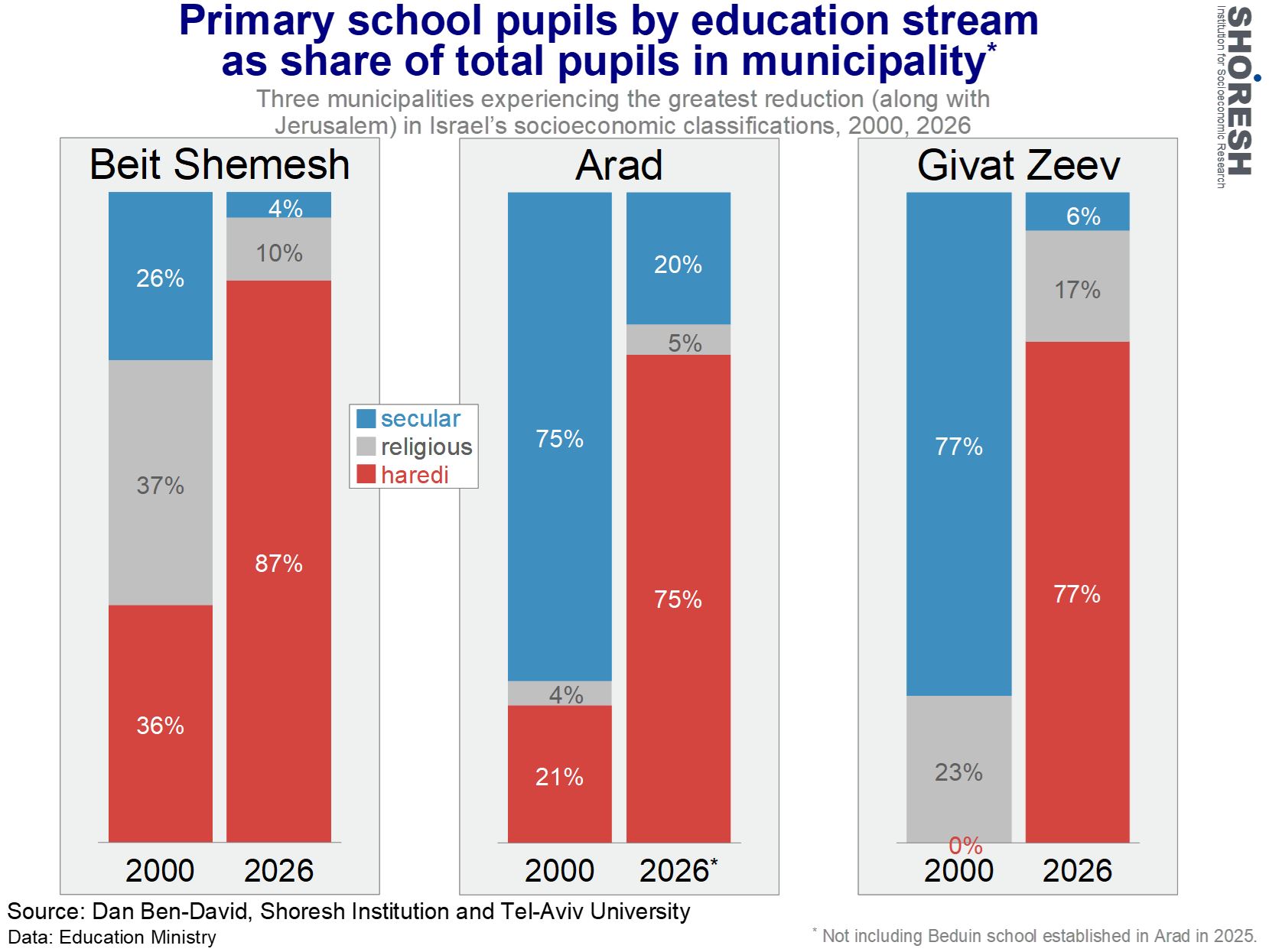
students three and a half decades ago to just 9% today. The town of Arad
vividly illustrates this demographic transformation. In 2000, 75% of its
primary-school students were in the secular Jewish stream and 21% in the Haredi
stream. By 2026, the shares had reversed: 75% were Haredi and 20% secular.
Haredi intolerance of all who are unlike them acts as an accelerant to the
process by driving away secular Israelis.
Other municipalities
are heading in the same direction as these. They have Israel to fund and defend
them. Whither thou goest Jerusalem, goest Israel? What will happen if the
entire nation begins to resemble these towns? This issue, in its various manifestations,
is the main existential challenge facing Israel in the upcoming October
elections, the most consequential in the country’s history. Key to pivoting
Israel onto a sustainable long-term path is a complete overhaul of its
education system. A primary pillar of this overhaul must be a significant
upgrade of the national core curriculum – still possible while Israel has some
of the world’s best universities to help shape more advanced educational
programmes. But an upgrade is not enough; the curriculum must also be
compulsory for every child. While non-core curricula can and should accommodate
local and parental preferences, no parent should be permitted to deny children
the basic education needed to compete in a global economy and understand the
fundamental principles of liberal democracy. Incentivizing this
education overhaul requires a fundamental shift in government budgetary
priorities, beginning with complete defunding of schools that do not provide
the upgraded core curriculum in its entirety. It continues with termination of
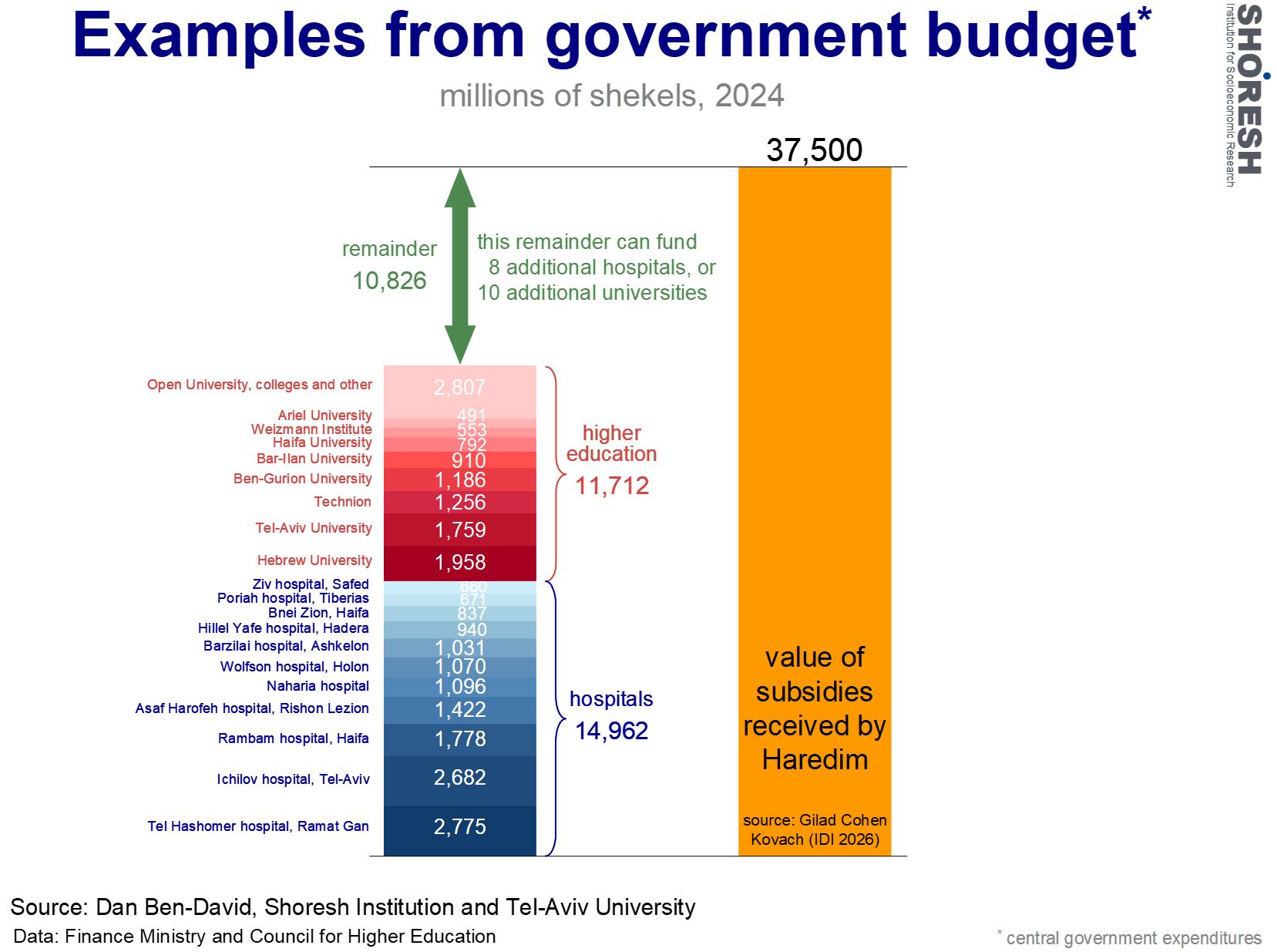
direct and in-kind subsidies to Haredim that currently exceed total public
funding for all of Israel’s hospitals and universities combined. Is it any
wonder that employment rates among prime working-age Haredi men are a quarter
lower today than in the late 1970s?
While
other developed countries are increasingly flirting with populism, demagoguery
and charlatanry in their primary corridors of power, with problematic omens for
their future and mankind’s – Israel provides a vivid example of where this can
lead. The worst four years in our history have made it clear where the nation
is headed. The October elections may provide the best opportunity yet to return
Israel to a sustainable path. It’s on us to separate the wheat from the chaff –
not throwing money at problems but dealing directly with their root causes. We
need leaders with the resolve for a complete overhaul of Israel’s education
system and budgetary priorities while it’s still possible to find a Knesset
majority to do so. |